From tools to agents: how AI is changing event technology and what to do about it
From tools to agents: how AI is changing event technology and what to do about it
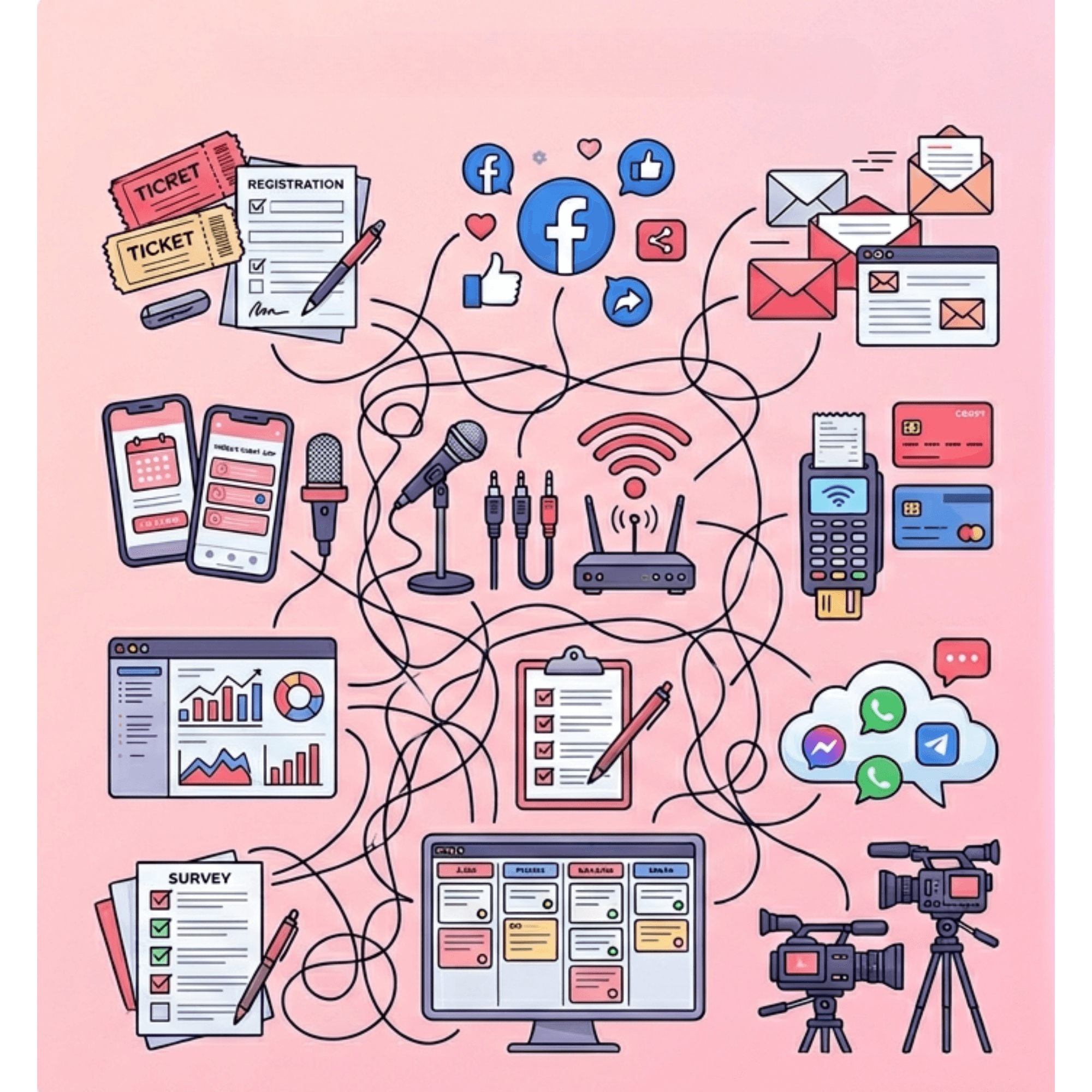
There's a particular kind of exhaustion that creeps up on event professionals around year three of a new platform. The demo was compelling. The onboarding went fine. And yet somehow, the work hasn't gotten easier. It's just moved. Tasks that used to live in spreadsheets now live in dashboards. Decisions that used to require a phone call now require logging into three different systems to pull the information together yourself.
This isn't a complaint about any specific vendor. It's a structural problem with how the events industry has approached technology for the better part of a decade. We've been buying tools. Lots of them. And tools, by their nature, require someone to pick them up.
That's about to change.
The tool decade: more platforms, not necessarily more progress
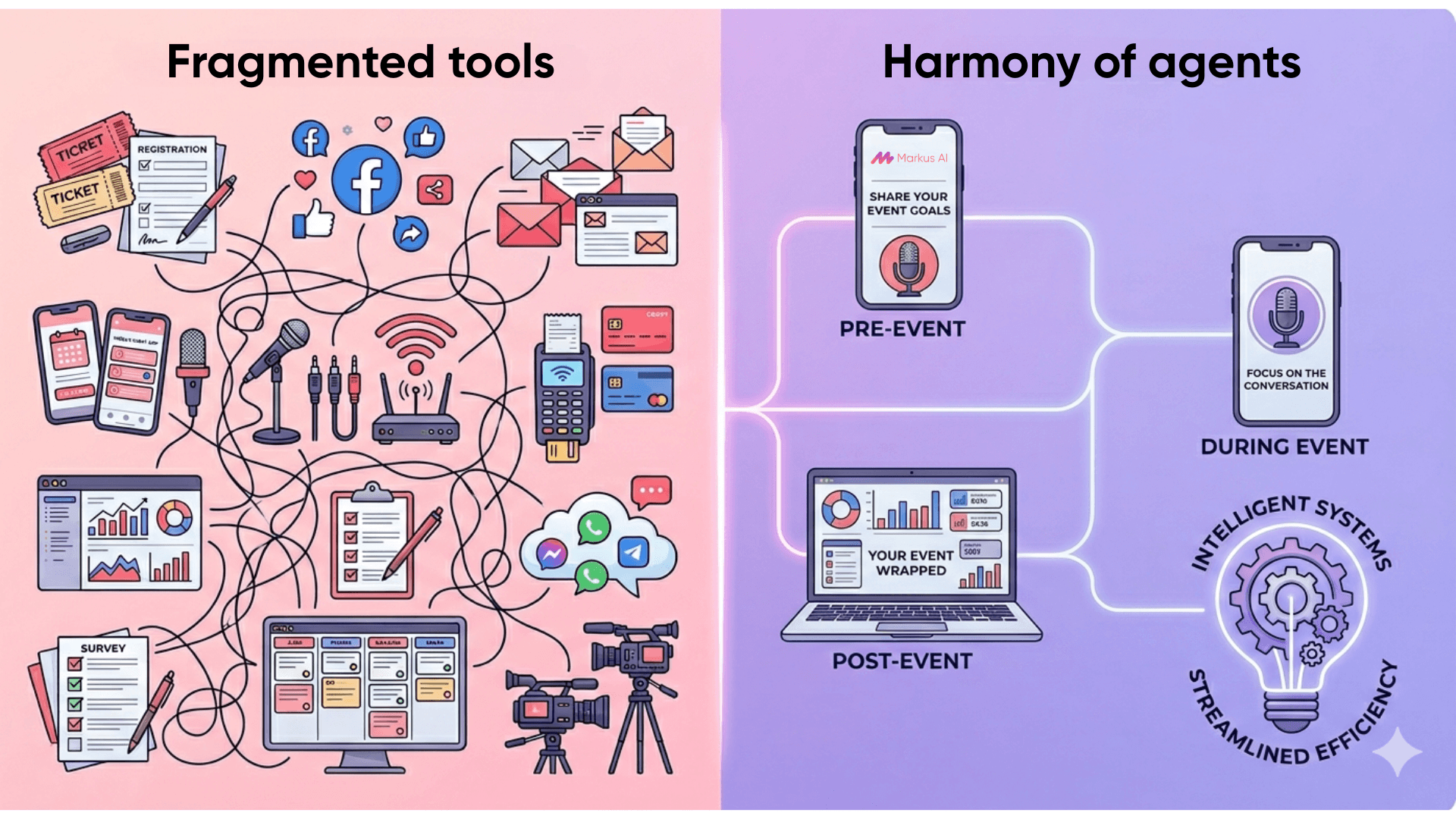
Cast your mind back over the last ten years of event tech investment. Registration platforms. Event apps. Hybrid streaming tools. Lead retrieval. Session management. Attendee intelligence. Exhibitor portals. Email automation. Each category emerged because there was a genuine need. Each promised to reduce friction. Most delivered, partially.
The problem is that tools don't talk to each other unless you make them. And even when integrations exist, they move data, not decisions. You still have to log in, pull the report, interpret it, decide what to do, and then go do it, usually across multiple platforms in sequence. The coordination work doesn't disappear; it just becomes invisible, absorbed into someone's working day.
For a senior event director managing a portfolio of events, this compounds quickly. Time lost context-switching between systems. The mental overhead of knowing which platform holds the authoritative version of any given piece of information. The creeping sense that your team is spending more energy managing the stack than actually running events.
The tool decade gave us capability. What it didn't give us was leverage.
The rise of agents: what changes when software acts on your behalf
The shift that's beginning to happen, slowly and then probably all at once, is a move from tools you operate to agents that operate on your behalf.
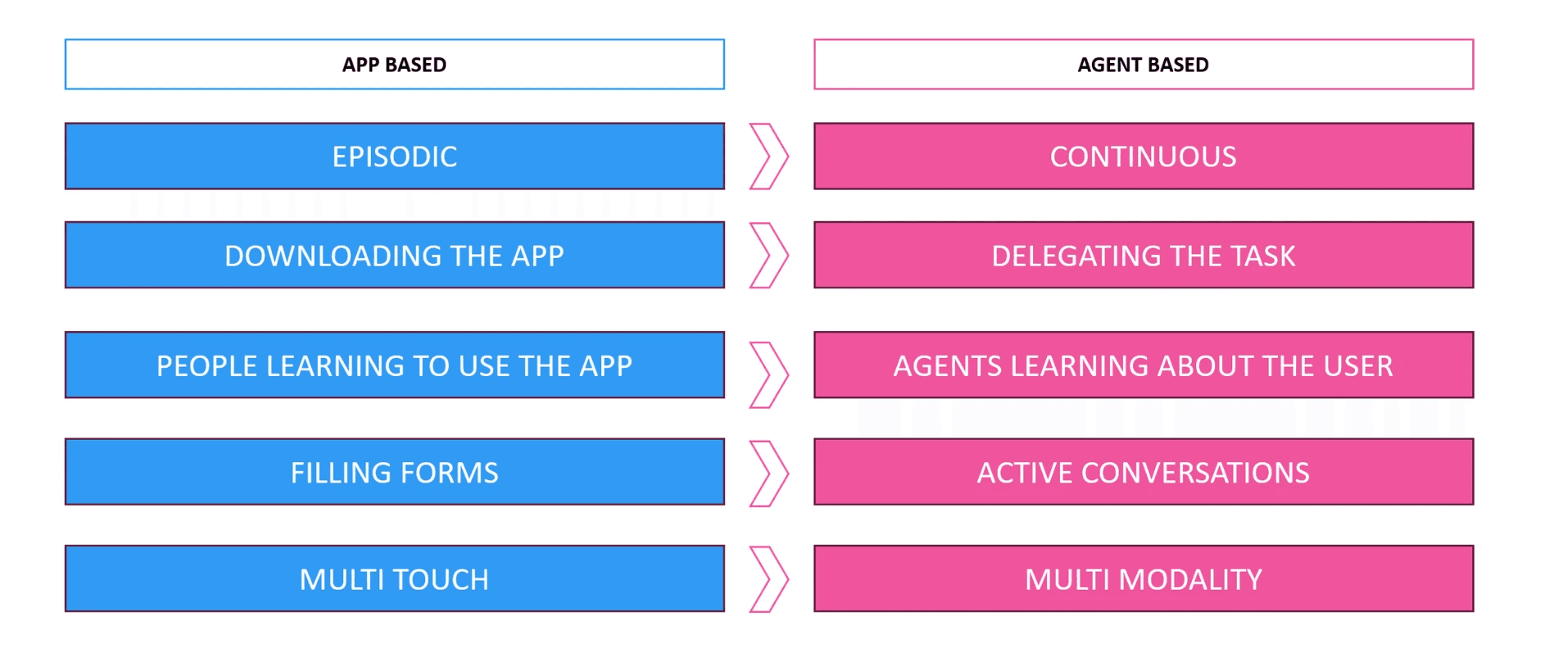
The distinction matters more than it might initially seem. A tool waits for you. An agent works toward a goal. A tool gives you information; an agent acts on it. A tool is passive until invoked; an agent is continuously oriented toward outcomes.
Agent-based systems can do three things that conventional software can't.
They're context-aware. An agent doesn't just access data; it understands the relationship between data points. It can hold multiple variables in view simultaneously and reason across them, something that previously required a human analyst or a very patient ops manager.
They're task-oriented, not feature-oriented. You don't navigate to a module. You tell the agent what you're trying to achieve and it figures out the sequence of actions required across whatever systems it has access to. The interface is the goal, not the menu.
They're cross-system by design. Where integrations connect platforms at the data layer, agents operate at the action layer, reading from one system, making a judgment, and writing to another. They're not just moving information; they're moving work.
To make this concrete, consider what's already possible with Markus AI. Before an event, a specially trained event agent captures what each attendee is actually trying to achieve, not just their job title, but their goals for the event. From that, it builds a personalized event success plan: which sessions are worth their time, which exhibitors are relevant to their priorities and who they should make a point of meeting. During the event, it handles note-taking in real time so attendees can be fully present in conversations rather than splitting their attention. When the event ends, it produces a structured follow-up report that captures outcomes, surfaces priorities, and turns the week's interactions into a clear set of next actions.
No manual data entry. No post-event scramble to remember what you promised who. No attendee arriving on day one wondering where to start.
That's not a fantasy from a vendor roadmap. It's agent-based thinking applied to events, and it's already working.
Shift in Expectations, Experience and Engagement
If the attendee wins, everyone wins
What makes this significant isn't just the convenience. It's what happens when attendees show up genuinely prepared.
An attendee who arrives knowing their goals, understanding which exhibitors map to those goals, and walking into conversations with relevant context isn't just having a better experience. They're having more productive conversations. They're making targeted visits, asking informed questions, and engaging with exhibitors in ways that feel meaningful rather than transactional.
That changes the quality of every interaction on the floor. And that matters enormously for exhibitors.
An exhibitor's measure of success has never really been footfall. It's qualified conversations, the ones that turn into pipeline, into partnerships, into reasons to come back next year. When attendees are better prepared and better directed, exhibitors stop fielding vague enquiries from people who wandered past the stand and start having conversations that justify the investment. The ROI story becomes easier to tell internally. The case for rebooking writes itself.
This is the dynamic that event marketing and sales teams should pay close attention to. Exhibitor rebooking is one of the most consequential commercial metrics in the events business, and it's driven almost entirely by perceived value. Exhibitors rebook when they believe the event delivered something worth paying for. That belief is shaped entirely by the quality of the conversations they have on the floor.
When the attendee wins, the exhibitor wins. When the exhibitor wins, the organizer wins. Agent-based technology applied at the attendee level doesn't just improve individual experience. It strengthens the commercial relationships the entire event economy depends on. That's not a marginal improvement. It's a structural one.
What this means for event organizers: new expectations, new risks
The upside is significant. Agent-based systems promise to return something genuinely valuable to senior event professionals: the headspace to focus on work that actually matters.
For event directors, that means less time on operational coordination and more time on the relationships, strategic calls, and creative decisions that shape a great event.
For event marketers, it means less time on the mechanics of segmentation, campaign sequencing, and post-event reporting, and more time on audience insight, sharper messaging, and the attendee engagement strategy that drives registration, retention, and advocacy.
In both cases, the shift is the same. Less time managing the process. More time influencing the outcome.
But the risks are real and worth naming.
Accountability gets complicated. When an agent sends an email to 4,000 attendees or reallocates budget across campaign lines, who owns that decision? Most event teams have processes that assume a human was the last one to act. That assumption needs revisiting.
Context collapse is a genuine hazard. Agents are only as good as the context they're given. One that doesn't know about a sensitive sponsor relationship or a geopolitical consideration relevant to your attendee base could cause real damage acting in apparent good faith. Briefing an agent well matters as much as briefing a new team member, possibly more.
Vendor dependency intensifies. The more your operations are embedded in an agent's logic and memory, the harder it becomes to switch. Evaluate agent-based tools with the same scrutiny you'd apply to core infrastructure.
None of these are reasons to wait. They're reasons to move thoughtfully.
A pragmatic path: how to start without throwing away your stack
You don't need to make a big bet right now. The agent layer is still forming. What you can do is position yourself to learn faster than the field.
Start with pain, not technology. The most productive question isn't "how do we use AI agents?" It's "where do we spend the most time on work that shouldn't require human judgment?" Look at your existing workflow honestly. For most event marketers and event directors, attendee intent is a blindspot. You know job titles, not goals. You have registration data, but not the audience intelligence that tells you what your attendees are actually trying to achieve, what content will resonate, or which exhibitor categories are most in demand. That's exactly the kind of gap an agent can close, and a natural first test case.
Think in terms of supervised autonomy. Agents that prepare, draft, and recommend, with humans reviewing before any consequential action is taken. This gives you the leverage without the exposure, and the data you need to calibrate trust over time.
Audit your data foundations. Agents are only as capable as the data they can access. Before evaluating any agent-based capability, do an honest audit of where your critical event data lives, how clean it is, and whether it's machine-readable. The limiting factor is often the data, not the AI.
Ask harder questions of vendors. The industry is about to be flooded with "AI-powered" everything. Most of it will be conventional software with a chat interface bolted on. The meaningful distinction is whether a system can take actions across platforms, maintain context over time, and operate with genuine autonomy toward a defined goal. Ask specifically about those capabilities, and ask about guardrails, error handling, and audit trails.
Protect your institutional knowledge. Agents are most powerful when they understand how your organization actually works, your conventions, constraints, and stakeholder sensitivities. Start documenting that knowledge now. The organizations that get the most from agent-based systems will be the ones that can articulate clearly how they operate.
Know the risks before you scale. As you experiment, keep accountability front of mind. Define clearly what decisions agents can make autonomously, what requires human sign-off, and how errors get surfaced and resolved. The teams that scale agent-based tools successfully won't be the most aggressive adopters. They'll be the most deliberate ones.
We're at ‘Day Zero’ with agentic AI
We're at an inflection point. Not the kind that makes the front page of the trade press, but the kind that you recognise in retrospect as the moment things started to shift. The technology is capable enough to be genuinely useful. The early use cases are proving out. And the gap between event teams that are experimenting and those that aren't is starting to open up.
"Day zero" isn't a prediction that everything changes at once. It's a marker. You are here.
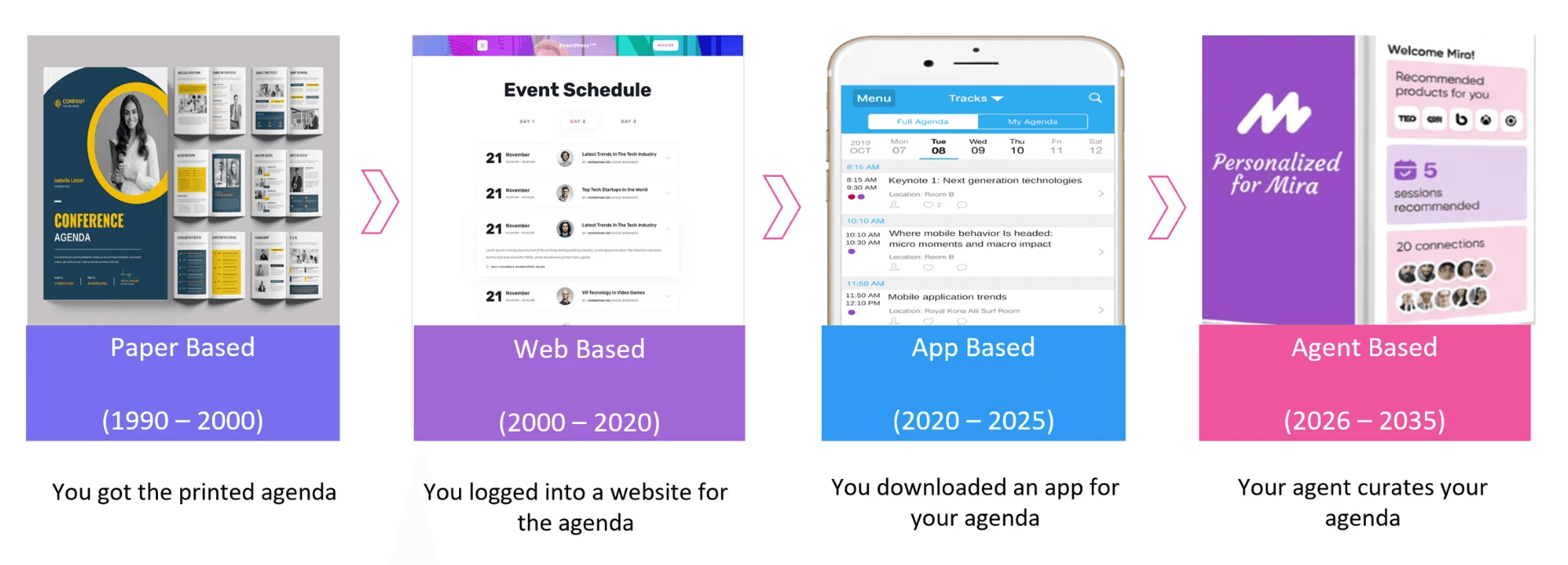
Change in the events industry rarely announces itself. Event apps didn't arrive with a fanfare; they just quietly became something every attendee expected. Hybrid didn't replace live events overnight; it gradually reshaped how organizers thought about audience and reach. The professionals who benefited most weren't the ones who moved fastest. They were the ones who started paying attention early.
That's all this is. An invitation to start paying attention.
Your existing stack isn't going anywhere. Agents will work alongside what you already have, not replace it. But the way your team works, where the time goes, what decisions get made by people versus systems, is going to change. Not dramatically, not immediately, but steadily and then irreversibly.
The event professionals who engage with that now will be the ones who shape what good looks like for everyone else. The question isn't whether this shift is coming. It's whether you're ready for it.
If you’re ready to explore how AI agents can support your events - get in touch connect@dearmarkus.ai
There's a particular kind of exhaustion that creeps up on event professionals around year three of a new platform. The demo was compelling. The onboarding went fine. And yet somehow, the work hasn't gotten easier. It's just moved. Tasks that used to live in spreadsheets now live in dashboards. Decisions that used to require a phone call now require logging into three different systems to pull the information together yourself.
This isn't a complaint about any specific vendor. It's a structural problem with how the events industry has approached technology for the better part of a decade. We've been buying tools. Lots of them. And tools, by their nature, require someone to pick them up.
That's about to change.
The tool decade: more platforms, not necessarily more progress
Cast your mind back over the last ten years of event tech investment. Registration platforms. Event apps. Hybrid streaming tools. Lead retrieval. Session management. Attendee intelligence. Exhibitor portals. Email automation. Each category emerged because there was a genuine need. Each promised to reduce friction. Most delivered, partially.
The problem is that tools don't talk to each other unless you make them. And even when integrations exist, they move data, not decisions. You still have to log in, pull the report, interpret it, decide what to do, and then go do it, usually across multiple platforms in sequence. The coordination work doesn't disappear; it just becomes invisible, absorbed into someone's working day.
For a senior event director managing a portfolio of events, this compounds quickly. Time lost context-switching between systems. The mental overhead of knowing which platform holds the authoritative version of any given piece of information. The creeping sense that your team is spending more energy managing the stack than actually running events.
The tool decade gave us capability. What it didn't give us was leverage.
The rise of agents: what changes when software acts on your behalf
The shift that's beginning to happen, slowly and then probably all at once, is a move from tools you operate to agents that operate on your behalf.
The distinction matters more than it might initially seem. A tool waits for you. An agent works toward a goal. A tool gives you information; an agent acts on it. A tool is passive until invoked; an agent is continuously oriented toward outcomes.
Agent-based systems can do three things that conventional software can't.
They're context-aware. An agent doesn't just access data; it understands the relationship between data points. It can hold multiple variables in view simultaneously and reason across them, something that previously required a human analyst or a very patient ops manager.
They're task-oriented, not feature-oriented. You don't navigate to a module. You tell the agent what you're trying to achieve and it figures out the sequence of actions required across whatever systems it has access to. The interface is the goal, not the menu.
They're cross-system by design. Where integrations connect platforms at the data layer, agents operate at the action layer, reading from one system, making a judgment, and writing to another. They're not just moving information; they're moving work.
To make this concrete, consider what's already possible with Markus AI. Before an event, a specially trained event agent captures what each attendee is actually trying to achieve, not just their job title, but their goals for the event. From that, it builds a personalized event success plan: which sessions are worth their time, which exhibitors are relevant to their priorities and who they should make a point of meeting. During the event, it handles note-taking in real time so attendees can be fully present in conversations rather than splitting their attention. When the event ends, it produces a structured follow-up report that captures outcomes, surfaces priorities, and turns the week's interactions into a clear set of next actions.
No manual data entry. No post-event scramble to remember what you promised who. No attendee arriving on day one wondering where to start.
That's not a fantasy from a vendor roadmap. It's agent-based thinking applied to events, and it's already working.
Shift in Expectations, Experience and Engagement
If the attendee wins, everyone wins
What makes this significant isn't just the convenience. It's what happens when attendees show up genuinely prepared.
An attendee who arrives knowing their goals, understanding which exhibitors map to those goals, and walking into conversations with relevant context isn't just having a better experience. They're having more productive conversations. They're making targeted visits, asking informed questions, and engaging with exhibitors in ways that feel meaningful rather than transactional.
That changes the quality of every interaction on the floor. And that matters enormously for exhibitors.
An exhibitor's measure of success has never really been footfall. It's qualified conversations, the ones that turn into pipeline, into partnerships, into reasons to come back next year. When attendees are better prepared and better directed, exhibitors stop fielding vague enquiries from people who wandered past the stand and start having conversations that justify the investment. The ROI story becomes easier to tell internally. The case for rebooking writes itself.
This is the dynamic that event marketing and sales teams should pay close attention to. Exhibitor rebooking is one of the most consequential commercial metrics in the events business, and it's driven almost entirely by perceived value. Exhibitors rebook when they believe the event delivered something worth paying for. That belief is shaped entirely by the quality of the conversations they have on the floor.
When the attendee wins, the exhibitor wins. When the exhibitor wins, the organizer wins. Agent-based technology applied at the attendee level doesn't just improve individual experience. It strengthens the commercial relationships the entire event economy depends on. That's not a marginal improvement. It's a structural one.
What this means for event organizers: new expectations, new risks
The upside is significant. Agent-based systems promise to return something genuinely valuable to senior event professionals: the headspace to focus on work that actually matters.
For event directors, that means less time on operational coordination and more time on the relationships, strategic calls, and creative decisions that shape a great event.
For event marketers, it means less time on the mechanics of segmentation, campaign sequencing, and post-event reporting, and more time on audience insight, sharper messaging, and the attendee engagement strategy that drives registration, retention, and advocacy.
In both cases, the shift is the same. Less time managing the process. More time influencing the outcome.
But the risks are real and worth naming.
Accountability gets complicated. When an agent sends an email to 4,000 attendees or reallocates budget across campaign lines, who owns that decision? Most event teams have processes that assume a human was the last one to act. That assumption needs revisiting.
Context collapse is a genuine hazard. Agents are only as good as the context they're given. One that doesn't know about a sensitive sponsor relationship or a geopolitical consideration relevant to your attendee base could cause real damage acting in apparent good faith. Briefing an agent well matters as much as briefing a new team member, possibly more.
Vendor dependency intensifies. The more your operations are embedded in an agent's logic and memory, the harder it becomes to switch. Evaluate agent-based tools with the same scrutiny you'd apply to core infrastructure.
None of these are reasons to wait. They're reasons to move thoughtfully.
A pragmatic path: how to start without throwing away your stack
You don't need to make a big bet right now. The agent layer is still forming. What you can do is position yourself to learn faster than the field.
Start with pain, not technology. The most productive question isn't "how do we use AI agents?" It's "where do we spend the most time on work that shouldn't require human judgment?" Look at your existing workflow honestly. For most event marketers and event directors, attendee intent is a blindspot. You know job titles, not goals. You have registration data, but not the audience intelligence that tells you what your attendees are actually trying to achieve, what content will resonate, or which exhibitor categories are most in demand. That's exactly the kind of gap an agent can close, and a natural first test case.
Think in terms of supervised autonomy. Agents that prepare, draft, and recommend, with humans reviewing before any consequential action is taken. This gives you the leverage without the exposure, and the data you need to calibrate trust over time.
Audit your data foundations. Agents are only as capable as the data they can access. Before evaluating any agent-based capability, do an honest audit of where your critical event data lives, how clean it is, and whether it's machine-readable. The limiting factor is often the data, not the AI.
Ask harder questions of vendors. The industry is about to be flooded with "AI-powered" everything. Most of it will be conventional software with a chat interface bolted on. The meaningful distinction is whether a system can take actions across platforms, maintain context over time, and operate with genuine autonomy toward a defined goal. Ask specifically about those capabilities, and ask about guardrails, error handling, and audit trails.
Protect your institutional knowledge. Agents are most powerful when they understand how your organization actually works, your conventions, constraints, and stakeholder sensitivities. Start documenting that knowledge now. The organizations that get the most from agent-based systems will be the ones that can articulate clearly how they operate.
Know the risks before you scale. As you experiment, keep accountability front of mind. Define clearly what decisions agents can make autonomously, what requires human sign-off, and how errors get surfaced and resolved. The teams that scale agent-based tools successfully won't be the most aggressive adopters. They'll be the most deliberate ones.
We're at ‘Day Zero’ with agentic AI
We're at an inflection point. Not the kind that makes the front page of the trade press, but the kind that you recognise in retrospect as the moment things started to shift. The technology is capable enough to be genuinely useful. The early use cases are proving out. And the gap between event teams that are experimenting and those that aren't is starting to open up.
"Day zero" isn't a prediction that everything changes at once. It's a marker. You are here.
Change in the events industry rarely announces itself. Event apps didn't arrive with a fanfare; they just quietly became something every attendee expected. Hybrid didn't replace live events overnight; it gradually reshaped how organizers thought about audience and reach. The professionals who benefited most weren't the ones who moved fastest. They were the ones who started paying attention early.
That's all this is. An invitation to start paying attention.
Your existing stack isn't going anywhere. Agents will work alongside what you already have, not replace it. But the way your team works, where the time goes, what decisions get made by people versus systems, is going to change. Not dramatically, not immediately, but steadily and then irreversibly.
The event professionals who engage with that now will be the ones who shape what good looks like for everyone else. The question isn't whether this shift is coming. It's whether you're ready for it.
If you’re ready to explore how AI agents can support your events - get in touch connect@dearmarkus.ai
Previous Article
Previous Article