Your Team Has AI Tools. That's Not the Same as AI Maturity.
Your Team Has AI Tools. That's Not the Same as AI Maturity.

Most teams think they're further along than they are
Buying a few AI tools feels like progress. It is progress, but it's only the second step. The real shift happens when the workflow gets rebuilt around AI, not just sped up by it.
Where you land on the curve matters more than it looks. It shapes your business priorities. It decides whether you're optimizing for more data, for new data, or for extending your team into parts of the show experience it could never reach before. Those are very different strategies, and each stage below points you toward a different one.
Full credit and a tip of the cap to Sharon Roessen at Terrapinn, who recently shared an exchange with Collingwood and sketched this AI maturity stage visual on a plane. It stuck with me, because it's the exact conversation we are having with top event organizers right now. If you want a real look at how one organizer is thinking deeply about AI and workflows, she is well worth a follow.
Here are the five stages, and what each one looks like inside an event organization.
Stage 1: Ad hoc
Individual use, no shared standard
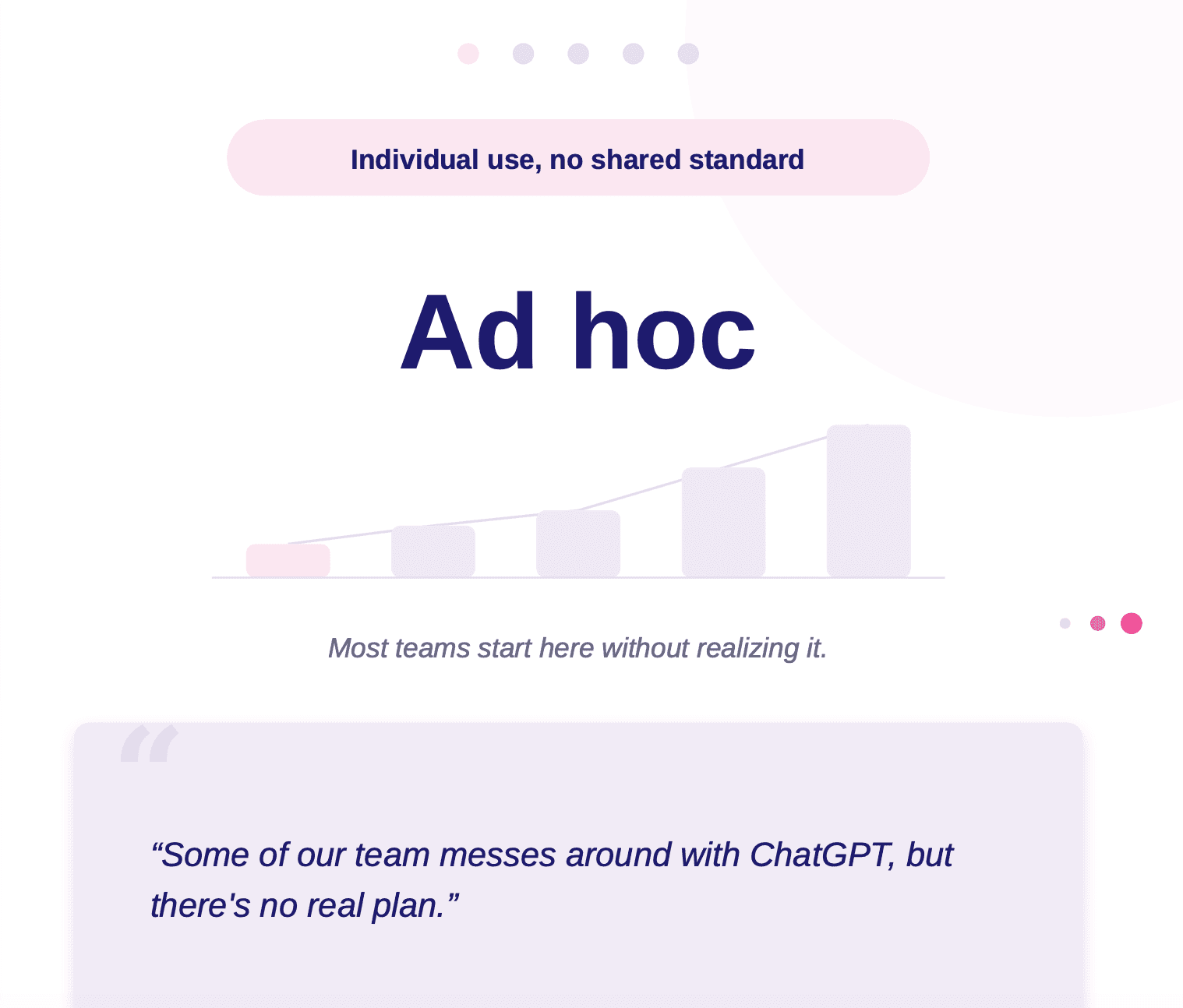
"Some of our team messes around with ChatGPT, but there's no real plan."
Most teams start here without realizing it. A marketer drafts promo emails with ChatGPT. Someone on the content team summarizes session abstracts. An ops lead builds a floor plan checklist with a chatbot. Each person is getting a little faster, but none of it is shared, repeatable, or measured.
What it looks like at an event: Pockets of productivity, no common prompts or guardrails, and no one who owns AI as a capability.
The priority at this stage: Speed on individual tasks. Nothing compounds yet.
How to move up: Set a shared baseline. Agree on approved tools, a data policy, and a small library of team prompts for your most repeated work. If your team needs a common foundation in prompting, IAEE's Master Series Certificate: AI Accelerator is a hands-on, three-part program built for exhibition and event professionals.
Stage 2: Tooled
Point solutions per function
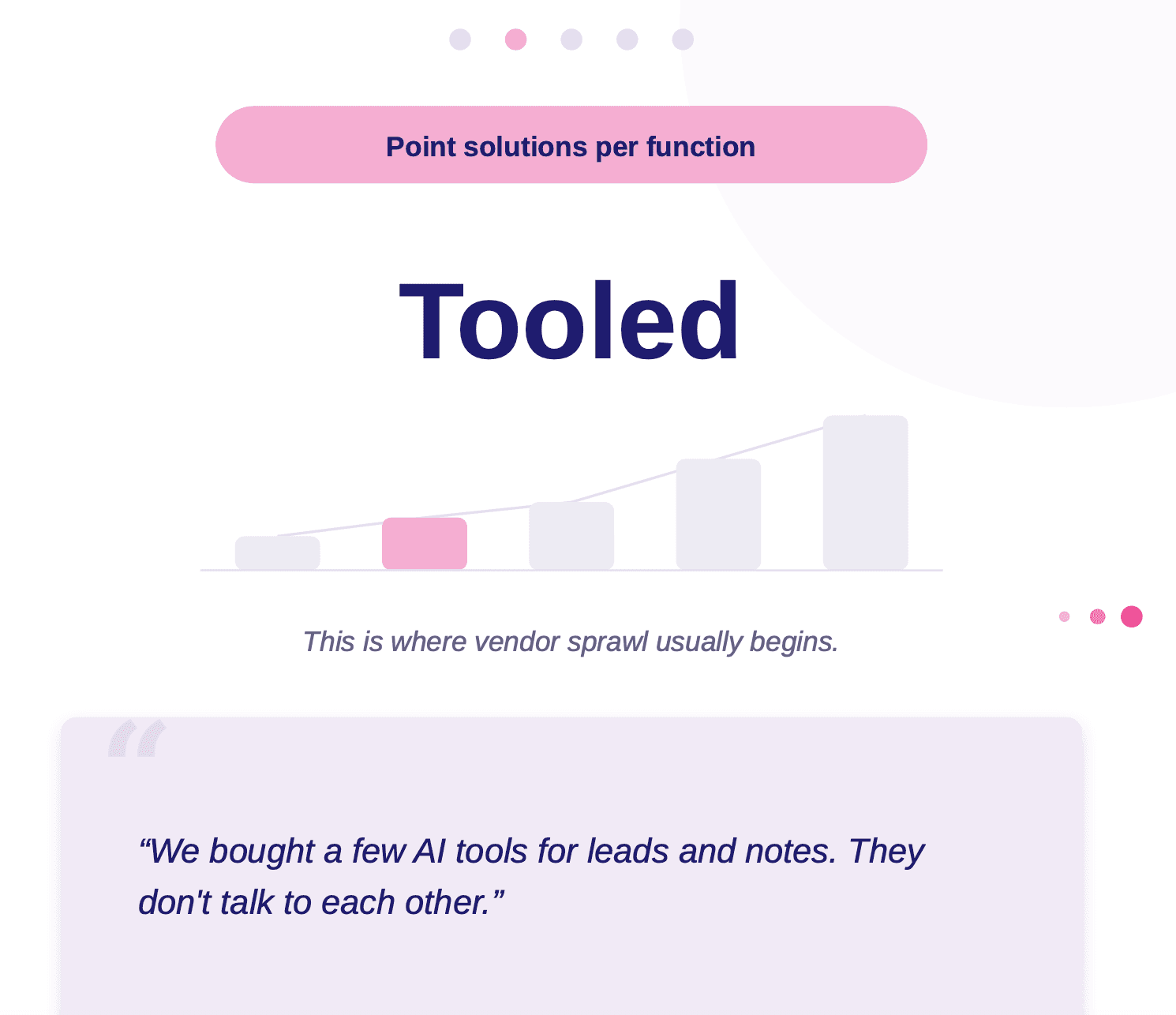
"We bought a few AI tools for leads and notes. They don't talk to each other."
This is where vendor sprawl usually begins. Registration has an AI feature. Sales has a lead scoring tool. Exhibitor services added a note taker. Marketing has its own content assistant. Every department can point to "our AI tool," and yet the data from each one lives in its own silo.
What it looks like at an event: Attendee signals in one system, exhibitor leads in another, session data in a third. Nobody sees the full picture of who came, what they cared about, and what happened next.
The priority at this stage: More data. You're capturing more than ever, but it isn't connected, so it doesn't turn into better decisions.
How to move up: Before buying the next tool, ask how it connects to the rest of your stack and who owns the combined view. It also pays to get sharper on what you're buying. IAEE's webinar How to Use AI in Your Event to Achieve Your Goals Safely covers the difference between curated and generative AI and the key questions to ask when vetting AI providers.
Stage 3: Embedded
Skills built into the workflow
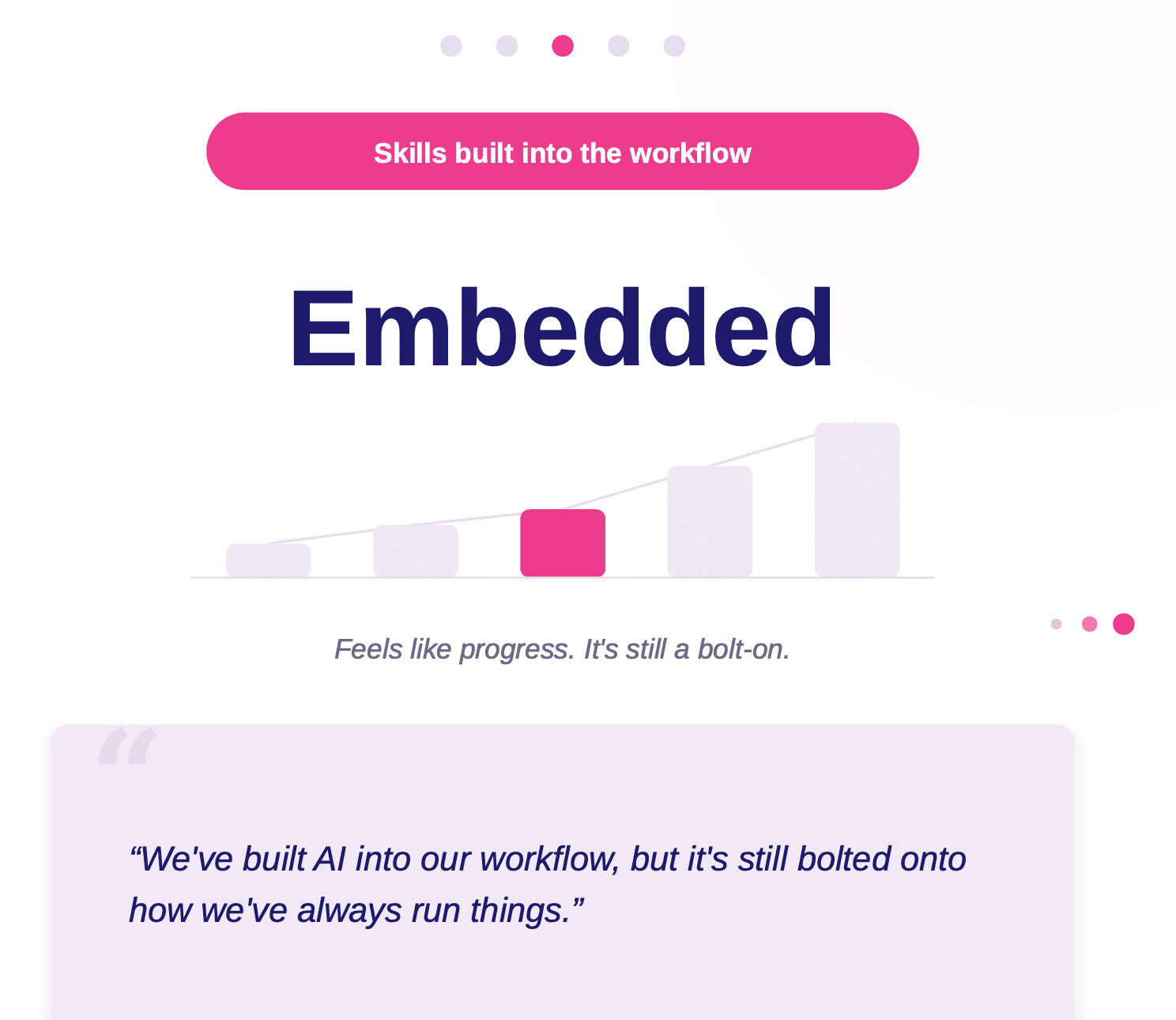
"We've built AI into our workflow, but it's still bolted onto how we've always run things."
This stage feels like real progress, and in many ways it is. AI is part of the daily process. Session recaps go out automatically. Exhibitor leads get enriched before the show floor closes. Attendee questions get answered without a ticket.
But the event itself runs the same way it always has. Same org chart, same timeline, same deliverables to sponsors. AI makes the old process faster. It doesn't change the process.
What it looks like at an event: Measurable time savings and fewer manual handoffs, but the same outcomes for attendees and sponsors, just delivered sooner.
The priority at this stage: Efficiency. A good place to be, but it's still a bolt-on.
How to move up: Pick one workflow and ask a harder question. Not "how can AI speed this up?" but "if we designed this from scratch with AI in the loop, what would it look like?"
Stage 4: Redesigned
The function rebuilt around AI
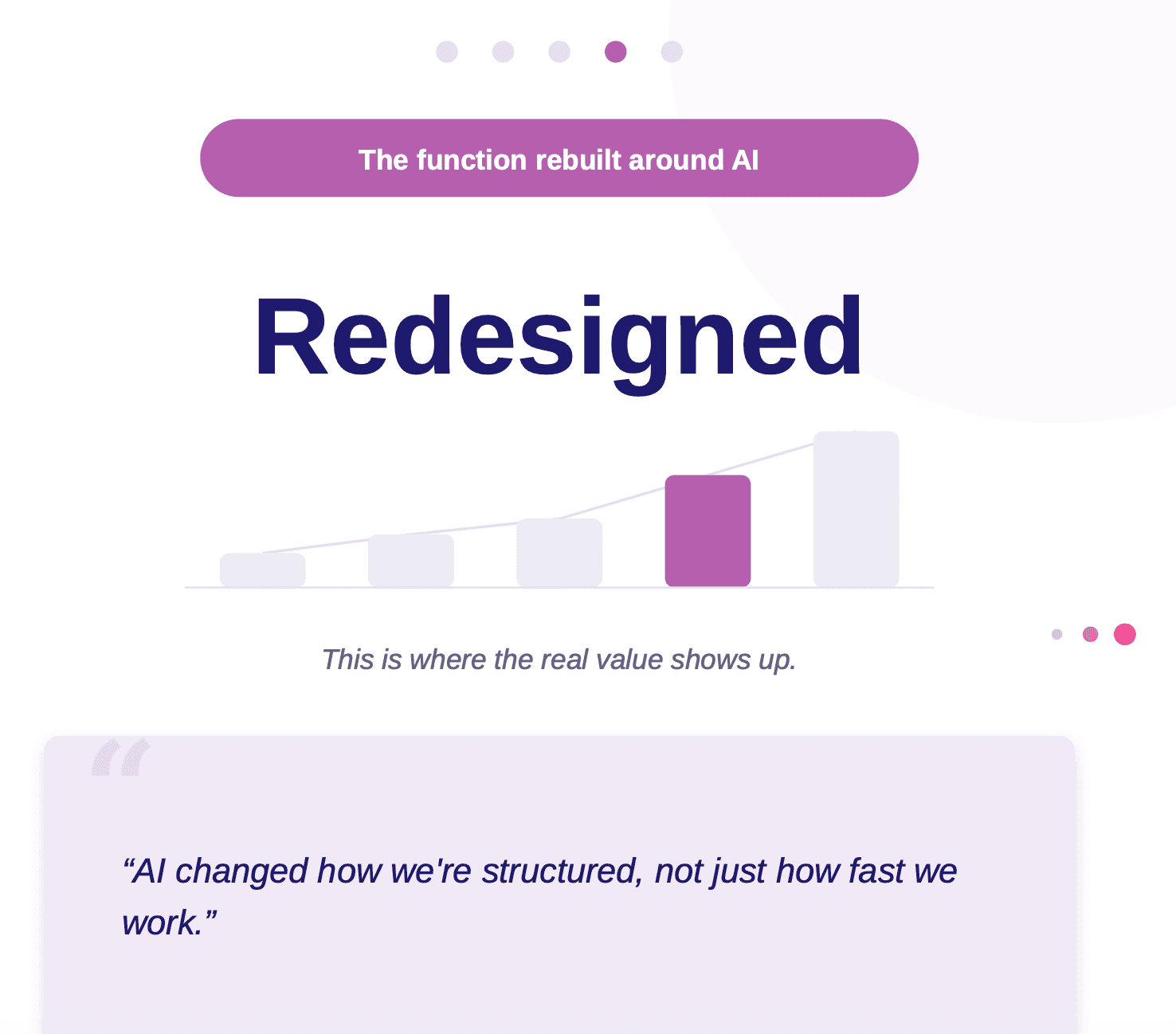
"AI changed how we're structured, not just how fast we work."
This is where the real value shows up. Instead of layering AI on top of existing roles, the team restructures around it. One person manages what used to take three. Work that was impossible at scale, like personalizing the agenda for every attendee or capturing insights from every buyer and seller meeting, becomes standard.
What it looks like at an event: Every attendee gets a personalized journey. Every sponsor meeting produces documented actions. The team spends its time on relationships and strategy, while AI handles capture, matching, and follow up.
The priority at this stage: New data. You're now capturing signals you never had before, like goals, intent, and meeting outcomes, because the workflow was built to collect them.
How to move up: Start treating that new data as an asset, not a byproduct. Ask what it's worth to your exhibitors, sponsors, and your own sales team.
Stage 5: Reimagined
AI changes what you sell
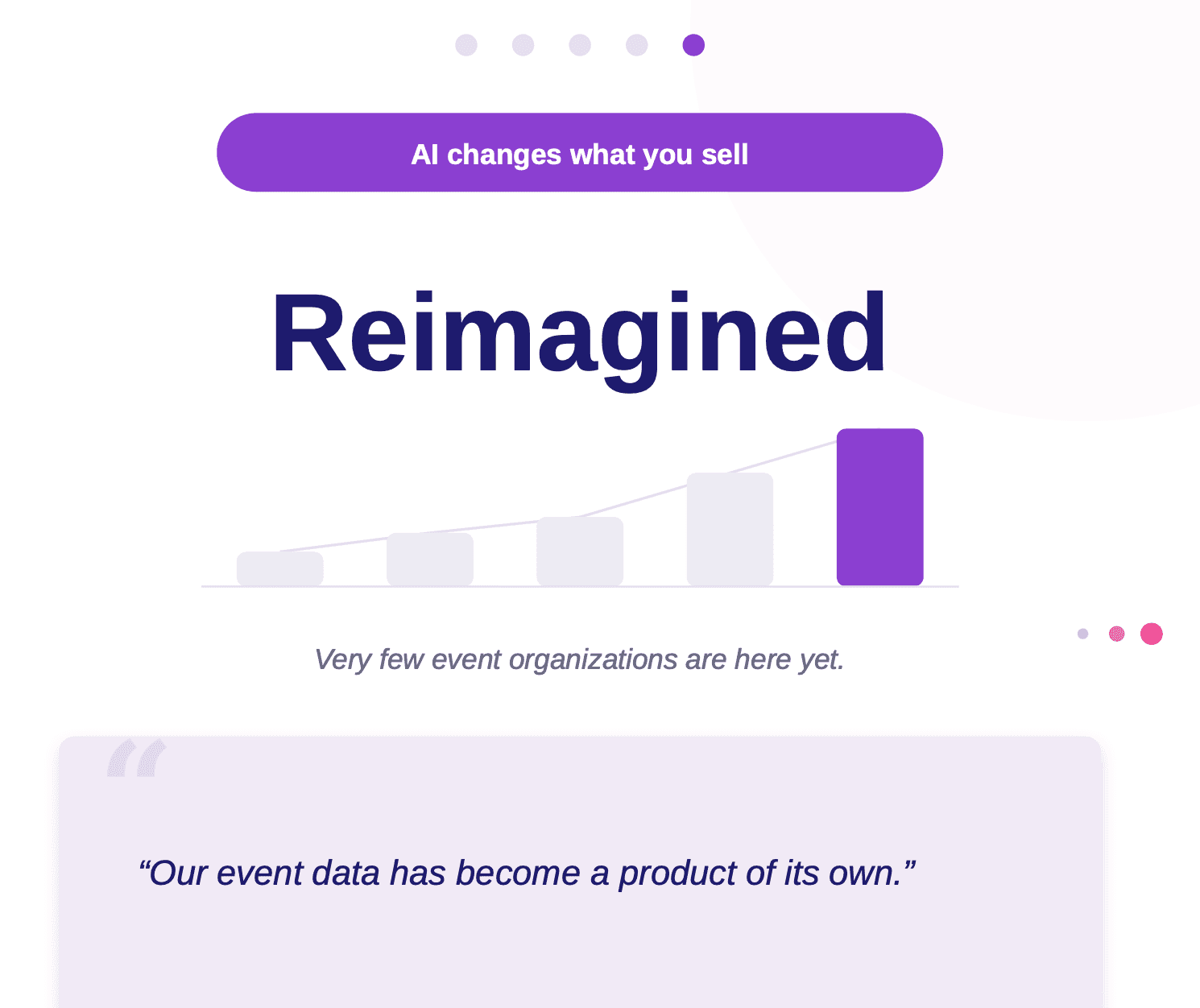
"We now offer new products and experiences because of how our team operates."
Very few event organizations are here yet. At this stage, AI doesn't just change how the show runs. It changes the business model.
Example: A tradeshow sells structured buyer intent data (who visited which sessions, what they asked about) as a report or dashboard layered on top of booth space.
Booth space and sponsorship packages stop being the only products. Organizers package intelligence, year round engagement, and measurable outcomes. The event becomes a platform, not just a moment on the calendar.
What it looks like at an event: New revenue lines, sponsors renewing on proven ROI rather than gut feel, and a team extended into parts of the show experience it could never reach on headcount alone.
The priority at this stage: Extending your team into the full event experience, and turning it into new value for everyone in the room.
Where does your team stand?
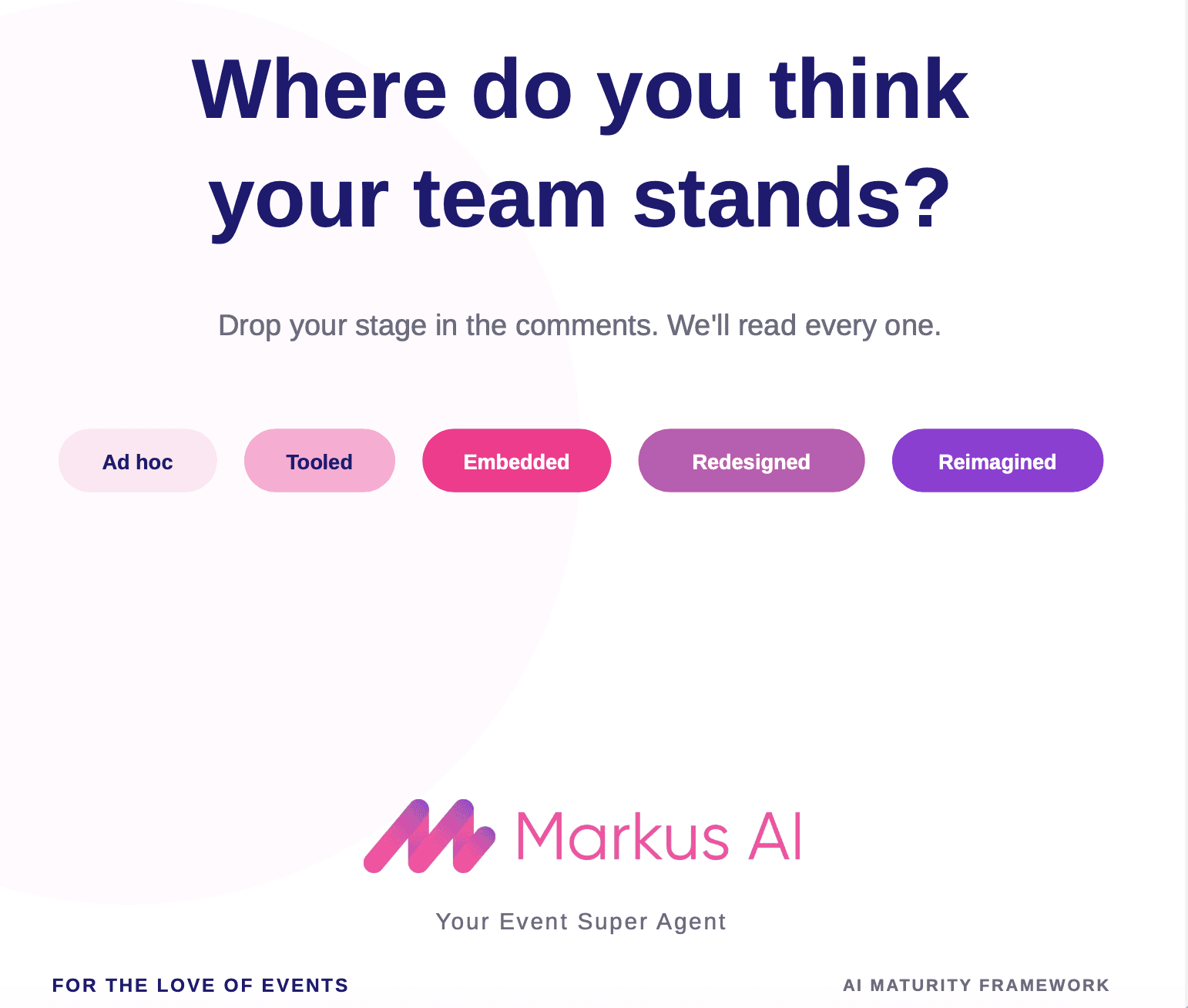
Be honest. Most teams we speak with land somewhere between Tooled and Embedded, and many are surprised by it. That's not a bad place to be. It's a starting line.
The questions worth asking your team this week:
Is our AI use shared and repeatable, or does it live with a few individuals?
Do our AI tools talk to each other, or are we adding to vendor sprawl?
Are we speeding up the old process, or designing a new one?
Are we optimizing for more data, new data, or new products?
Come assess it with us at IMEX
We're building out this framework with more examples and richer detail so event teams can truly assess where they stand. Our team will be presenting in the AI workshop at the Tech2GROW Collective booth and lounge all week at IMEX America in Las Vegas. Stop by, bring your team, and let's figure out your stage together.
If you've been having this conversation with your team, we'd love to hear your take. Join the discussion on LinkedIn and drop your stage in the comments.
About Markus AI
Markus AI is your Event Super Agent: an intelligence layer that runs across your existing event tech stack. Markus helps organizers move up the maturity curve without ripping and replacing what already works, delivering more personalization, more meaningful connections, and measurable ROI for attendees and sponsors. Learn more at dearmarkus.ai.
Sources & Resources
Sharon Roessen, Terrapinn, LinkedIn post on AI maturity stages
Paul De Barros, Markus AI, LinkedIn post: Where does your team stand?
IAEE, How to Use AI in Your Event to Achieve Your Goals Safely
Most teams think they're further along than they are
Buying a few AI tools feels like progress. It is progress, but it's only the second step. The real shift happens when the workflow gets rebuilt around AI, not just sped up by it.
Where you land on the curve matters more than it looks. It shapes your business priorities. It decides whether you're optimizing for more data, for new data, or for extending your team into parts of the show experience it could never reach before. Those are very different strategies, and each stage below points you toward a different one.
Full credit and a tip of the cap to Sharon Roessen at Terrapinn, who recently shared an exchange with Collingwood and sketched this AI maturity stage visual on a plane. It stuck with me, because it's the exact conversation we are having with top event organizers right now. If you want a real look at how one organizer is thinking deeply about AI and workflows, she is well worth a follow.
Here are the five stages, and what each one looks like inside an event organization.
Stage 1: Ad hoc
Individual use, no shared standard
"Some of our team messes around with ChatGPT, but there's no real plan."
Most teams start here without realizing it. A marketer drafts promo emails with ChatGPT. Someone on the content team summarizes session abstracts. An ops lead builds a floor plan checklist with a chatbot. Each person is getting a little faster, but none of it is shared, repeatable, or measured.
What it looks like at an event: Pockets of productivity, no common prompts or guardrails, and no one who owns AI as a capability.
The priority at this stage: Speed on individual tasks. Nothing compounds yet.
How to move up: Set a shared baseline. Agree on approved tools, a data policy, and a small library of team prompts for your most repeated work. If your team needs a common foundation in prompting, IAEE's Master Series Certificate: AI Accelerator is a hands-on, three-part program built for exhibition and event professionals.
Stage 2: Tooled
Point solutions per function
"We bought a few AI tools for leads and notes. They don't talk to each other."
This is where vendor sprawl usually begins. Registration has an AI feature. Sales has a lead scoring tool. Exhibitor services added a note taker. Marketing has its own content assistant. Every department can point to "our AI tool," and yet the data from each one lives in its own silo.
What it looks like at an event: Attendee signals in one system, exhibitor leads in another, session data in a third. Nobody sees the full picture of who came, what they cared about, and what happened next.
The priority at this stage: More data. You're capturing more than ever, but it isn't connected, so it doesn't turn into better decisions.
How to move up: Before buying the next tool, ask how it connects to the rest of your stack and who owns the combined view. It also pays to get sharper on what you're buying. IAEE's webinar How to Use AI in Your Event to Achieve Your Goals Safely covers the difference between curated and generative AI and the key questions to ask when vetting AI providers.
Stage 3: Embedded
Skills built into the workflow
"We've built AI into our workflow, but it's still bolted onto how we've always run things."
This stage feels like real progress, and in many ways it is. AI is part of the daily process. Session recaps go out automatically. Exhibitor leads get enriched before the show floor closes. Attendee questions get answered without a ticket.
But the event itself runs the same way it always has. Same org chart, same timeline, same deliverables to sponsors. AI makes the old process faster. It doesn't change the process.
What it looks like at an event: Measurable time savings and fewer manual handoffs, but the same outcomes for attendees and sponsors, just delivered sooner.
The priority at this stage: Efficiency. A good place to be, but it's still a bolt-on.
How to move up: Pick one workflow and ask a harder question. Not "how can AI speed this up?" but "if we designed this from scratch with AI in the loop, what would it look like?"
Stage 4: Redesigned
The function rebuilt around AI
"AI changed how we're structured, not just how fast we work."
This is where the real value shows up. Instead of layering AI on top of existing roles, the team restructures around it. One person manages what used to take three. Work that was impossible at scale, like personalizing the agenda for every attendee or capturing insights from every buyer and seller meeting, becomes standard.
What it looks like at an event: Every attendee gets a personalized journey. Every sponsor meeting produces documented actions. The team spends its time on relationships and strategy, while AI handles capture, matching, and follow up.
The priority at this stage: New data. You're now capturing signals you never had before, like goals, intent, and meeting outcomes, because the workflow was built to collect them.
How to move up: Start treating that new data as an asset, not a byproduct. Ask what it's worth to your exhibitors, sponsors, and your own sales team.
Stage 5: Reimagined
AI changes what you sell
"We now offer new products and experiences because of how our team operates."
Very few event organizations are here yet. At this stage, AI doesn't just change how the show runs. It changes the business model.
Example: A tradeshow sells structured buyer intent data (who visited which sessions, what they asked about) as a report or dashboard layered on top of booth space.
Booth space and sponsorship packages stop being the only products. Organizers package intelligence, year round engagement, and measurable outcomes. The event becomes a platform, not just a moment on the calendar.
What it looks like at an event: New revenue lines, sponsors renewing on proven ROI rather than gut feel, and a team extended into parts of the show experience it could never reach on headcount alone.
The priority at this stage: Extending your team into the full event experience, and turning it into new value for everyone in the room.
Where does your team stand?
Be honest. Most teams we speak with land somewhere between Tooled and Embedded, and many are surprised by it. That's not a bad place to be. It's a starting line.
The questions worth asking your team this week:
Is our AI use shared and repeatable, or does it live with a few individuals?
Do our AI tools talk to each other, or are we adding to vendor sprawl?
Are we speeding up the old process, or designing a new one?
Are we optimizing for more data, new data, or new products?
Come assess it with us at IMEX
We're building out this framework with more examples and richer detail so event teams can truly assess where they stand. Our team will be presenting in the AI workshop at the Tech2GROW Collective booth and lounge all week at IMEX America in Las Vegas. Stop by, bring your team, and let's figure out your stage together.
If you've been having this conversation with your team, we'd love to hear your take. Join the discussion on LinkedIn and drop your stage in the comments.
About Markus AI
Markus AI is your Event Super Agent: an intelligence layer that runs across your existing event tech stack. Markus helps organizers move up the maturity curve without ripping and replacing what already works, delivering more personalization, more meaningful connections, and measurable ROI for attendees and sponsors. Learn more at dearmarkus.ai.
Sources & Resources
Sharon Roessen, Terrapinn, LinkedIn post on AI maturity stages
Paul De Barros, Markus AI, LinkedIn post: Where does your team stand?
IAEE, How to Use AI in Your Event to Achieve Your Goals Safely